
INTRODUCTION
This memorandum analyses the implications of the Building Control (Amendment) Act, 2026 (herein after “the amendment”) on the operations of Financial Institutions, particularly in relation to commercial lending, construction finance, SME lending, project finance, collateral management, valuation, enforcement, and customer compliance obligations.
The memorandum further compares the amendments with the principal legislation, which is the Building Control Act, Cap. 136, and proposes measures financial institutions may adopt to ensure compliance while maintaining operational efficiency and customer service delivery.
OBJECTIVE OF THE AMENDMENT ACT:
The amendment act was enacted to strengthen the National Building Review Board, streamline approval procedures for building permits and occupation permits, strengthen Building Committees, enhance enforcement powers, increase penalties for building violations, and improve safety and accountability in building operations. Compared to the principal Act, the amendment significantly shifts the legal regime from a largely administrative compliance framework to a stricter enforcement-oriented regime.
KEY AMENDMENTS AND THEIR EFFECT ON FINANCIAL INSTITUTIONS:
-
Stronger enforcement powers against illegal or unsafe buildings
The amendment under Section 4 introduces Section 8A which grants broader powers to the Board while Section 6 and 7 respectively, establish the Building Committee and its powers. The Board and Committee powers include but are not limited to issuing stop orders, evacuation directives, demolition powers, site entry powers, and enforcement authority.
This creates heightened risks for the Bank in case the financed properties are non-compliant, this potentially reduces the collateral value of the properties and may render the properties unusable.
Operational implications:
Financial Institutions can no longer rely solely on registered title verification and valuation reports. They must verify regulatory compliance throughout the construction lifecycle.
-
Increased penalties for unauthorized construction.
The amendment under Sections 8, 12, 14, 17, and 21 introduces severe penalties calculated according to the built-up area of non-compliant structures.
Borrowers facing such penalties may experience financial distress, which in turn increases non-performing loans, leads to project delays coupled with an increase in restructuring requests, contractor disputes and foreclosure exposure. This is especially relevant for SME borrowers and medium-scale developers financed by financial institutions such as banks.
Operational implications:
Banks’ credit assessment models should incorporate building regulatory compliance risk as part of borrower risk evaluation.
-
Stricter structural design requirements.
Multi-storied structures under Section 9 of the Amendment must now include detailed structural engineering documentation, including stamped designs, registration details, and engineering calculations.
This amendment affects commercial real estate finance, mixed-use developments, apartment projects, shopping complexes, and industrial structures financed by financial institutions.
Operational implications:
Financial institutions should require independent technical review and structural verification before disbursement of project finance facilities.
-
Delayed permit processing and appeals.
The Amendment under Section 10 and 16 introduces mechanisms for deferred applications, re-submissions, complaints, and appeals where Building Committees delay decision-making.
While these improve administrative accountability, they may still cause project delays affecting loan disbursement timelines, contractor performance, project completion timelines and customer cash flows and realization of projected commercial income.
Operational implications:
Loan agreements should expressly address regulatory approval delays and define borrower obligations during deferred approval periods.
-
Expanded liability for building accidents.
The law under Section 17 amends Section 44 of the Principal Act by imposing heavier criminal liability for negligence causing building accidents, injury, death, or destruction of property.
Although the financial institution is not ordinarily the constructor, exposure may arise where the financial institution exercises substantial project control, appoints project consultants, or becomes directly involved in project supervision.
Operational implications:
Financial Institutions should clearly define the borrower’s responsibility for compliance and site safety. Particularly, the bank should ensure that responsibility for site safety and regulatory compliance remains contractually vested in borrowers, contractors, and project professionals.
-
Mandatory compliance with the National Building (Building Standards) Code.
The Amendment under Section 18 amends section 45 of the Principal Act to expressly require compliance with the National Building (Building Standards) Code, Non-compliant properties may become difficult to insure, occupy, or sell, thereby weakening the bank’s security.
Financial Institutions should therefore task the borrower to comply with the National Building (Building Standards) Code before disbursing the loan. And the banks’ credit assessment models should incorporate building regulatory compliance risk as part of borrower risk evaluation.
-
Recognition of unconventional building technologies.
The amendment under Section 15 introduces Section 41A into the Principal Act which allows approval of unconventional building technologies and materials.
This creates opportunities for financial institutions to support affordable commercial infrastructure, green financing products, sustainable construction financing, and innovative SME construction solutions. However, financial institutions must verify that such technologies receive formal approval required by the law before financing.
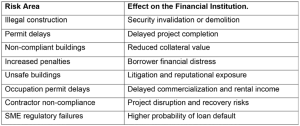
OVERALL LEGAL AND COMMERCIAL RISKS.
The amendment substantially increases regulatory risk in construction and commercial real estate financing.
The major risks include;
RECOMMENDED MEASURES.
Strengthen pre-disbursement due diligence.
-
-
Financial Institutions should require: approved building permits, structural engineering approvals, occupational permits where applicable, proof of Building Committee approvals and compliance certificates.
-
Introduce regulatory compliance conditions in loan agreements
“Loan documentation should include:”
“Warranties on statutory compliance.”
“Undertakings to maintain valid permits.”
“Mandatory compliance with the National Building Code..
-
Adopt construction monitoring systems.
Financial Institutions should implement periodic inspections and monitoring for financed developments, especially commercial projects, apartments, high-rise developments and estate projects.
-
Strengthen valuation and technical review standards.
Valuers and technical consultants engaged by the financial institution should confirm compliance with building permits, structural integrity, approved materials and methods and conformity with Building Committee approvals.
-
Create specialized construction compliance units.
Financial Institutions should establish a multi-disciplinary internal unit comprising of legal officers, engineers, valuers, project finance officers and risk specialists.
-
Enhance borrower awareness.
Financial Institutions should educate borrowers regarding permit obligations, occupation permits, approved building methods, penalties for non-compliance, and risks of unauthorized construction.
-
Review insurance requirements.
Financial Institutions should require construction all-risk insurance, public liability insurance, contractor insurance, and professional indemnity coverage for major projects from all intending borrowers.
-
Develop green and compliant housing products.
Given the recognition of unconventional building technologies, financial institutions should develop financing products for sustainable housing, low-cost housing technologies, and environmentally compliant developments.
CONCLUSION.
The Building Control (Amendment) Act, 2026 significantly strengthens Uganda’s building regulation regime through enhanced enforcement powers, stricter compliance obligations, heavier penalties, and stronger oversight mechanisms. For financial institutions, the amendments increase operational, legal, and credit risks associated with construction and mortgage financing. However, they also provide opportunities to improve risk management, strengthen portfolio quality, and support compliant and sustainable housing development.
Financial Institutions should therefore revise its lending policies, compliance frameworks, due diligence standards, and customer engagement processes to align with the amended law while continuing to provide efficient financial services to its clients.
-
-
